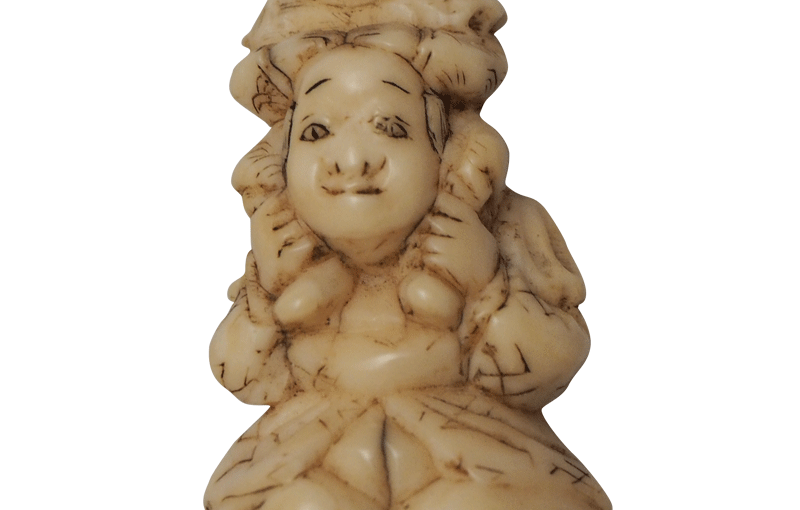

Initially, I did not know what this small carved figure of a man represented: a samurai with a child, but what was the feature of this beautiful object? It was equipped with two holes, one of one centimeter at the base and the other, smaller, on the back. And it is these holes that intrigued me. After searching on the Internet and taking the time to test if it was ivory, I was rapidly convinced that this carved item was the distant ancestor of our sewing buttons and that it was Japanese: the Netsuke. Indeed, the Netsuke is an extremely refined carved button. Did you know that all its surfaces are smooth to avoid damaging the fabric of the kimono, much less hurt the man that wears it? Did you know that they often featured human figures, life scenes or animals? Besides being functional, the Netsuke also symbolized a social rank, sometimes a trade or expressed for some of them, among the most rare, a carved love scene!

And all because kimonos have no pockets, the Netsuke was simply the button that allowed its owner to attach a box (sagemono) to the kimono by a string, containing his belongings. So refined, a button really deserves a name to the delicate pronunciation of Net-su-ke!
